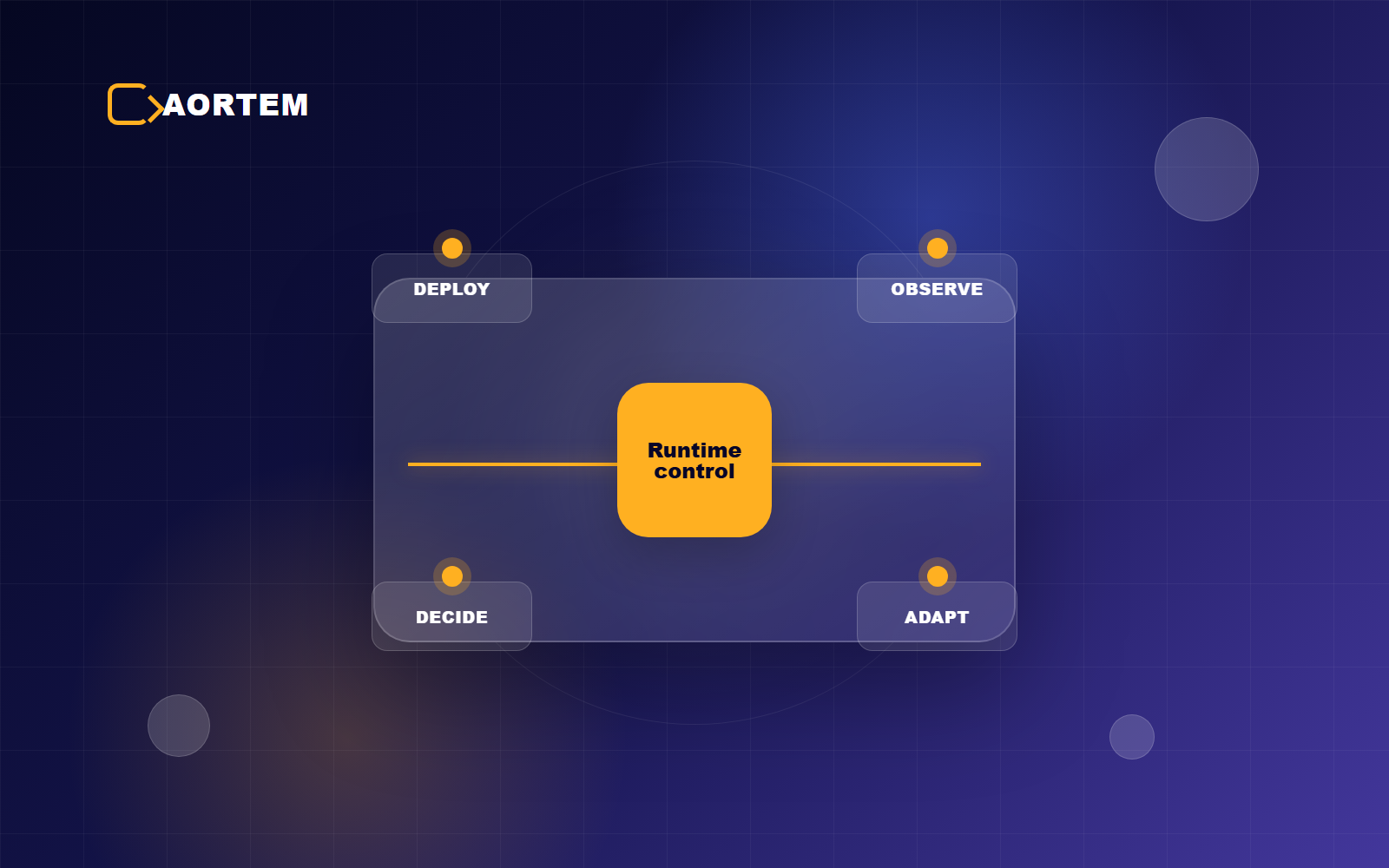
AI-native backends are changing how software teams think about runtime control. Many teams believe they control their systems because they can deploy code, but that assumption is breaking down.
At scale, modern applications are no longer defined by how fast you ship features. They are defined by how safely you can control what those features do after they are already live.
This is the shift most teams only recognize once production behavior becomes harder to predict than deployment itself.
The hidden misunderstanding in modern development
Most teams optimize for:
- clean architecture
- fast deployments
- simple backend abstractions
- predictable release cycles
This works early.
But once real users enter the system at scale, something changes.
The system stops behaving like code.
It starts behaving like a live environment with unpredictable interactions.
And at that point, deployment is no longer the control mechanism.
The real shift: from building apps to operating systems
Software development goes through three stages:
1. Build phase
Everything is predictable:
- features behave as expected
- deployments are controlled
- testing matches production closely
2. Usage phase
Reality starts diverging:
- users interact in unexpected ways
- edge cases appear in production only
- small changes create large side effects
3. Operational phase
This is where most teams struggle:
- rollback becomes risky
- debugging requires reconstruction of runtime state
- deployment is no longer enough to manage behavior
At this stage, the real question changes.
It is no longer:
“Can we ship this feature?”
It becomes:
“Can we safely control how this feature behaves after it is live?”
Why this problem keeps showing up
Most modern backend and Flutter-heavy systems rely on:
- frontend-driven logic
- Firebase-style backend abstraction
- deployment-based release control
This creates a gap.
Teams can control when code ships
but not how behavior evolves in production.
And that gap becomes expensive at scale.
What failure looks like in real systems
When runtime control is missing, production issues stop looking like crashes.
They look like:
- feature flags affecting only certain devices
- inconsistent backend state across sessions
- silent behavior changes after updates
- bugs that disappear after rollback
Nothing is fully broken.
Everything is partially inconsistent.
And that is what makes debugging expensive.
Because you are no longer fixing code,
you are reconstructing system history.
The cost most teams don’t calculate
Without runtime control:
- rollbacks become unreliable
- experiments become risky
- debugging becomes reactive instead of deterministic
- small changes produce unpredictable system-wide effects
At scale, this becomes the real bottleneck, not development speed.
For AI-native backends, this operational layer is where product velocity becomes measurable. Teams can observe decisions, route behavior, and change system rules without treating every adjustment as a new release.
The industry shift happening now
Across modern engineering systems, one pattern is becoming clear:
Control is moving away from deployment time
and closer to runtime behavior.
We’ve already seen this shift before:
- CI/CD reduced manual deployment control
- feature flags introduced controlled rollouts
- observability systems emerged for runtime debugging
Each time, the goal was the same:
move control closer to live system behavior
Where Aortem fits into this shift
Aortem is built around this reality:
Modern backend systems need more than deployment pipelines.
They need runtime control layers that allow developers to safely manage:
- feature behavior in production
- backend execution logic
- controlled rollouts and experimentation
- system-wide visibility across live environments
This is the foundation behind tools like:
- Dart Cloud Functions
- IntelliToggle (feature control layer)
- Aortem backend ecosystem
The goal is simple:
make production behavior safe to change, not just deployable.
Closing insight
Most applications don’t fail because code is wrong.
They fail because control happens too early in the system lifecycle.
Deployment is only the delivery mechanism.
Real control happens at runtime.
And once teams recognize that, the definition of “good engineering” changes completely:
- from shipping faster
- to operating systems safely in production
That is the shift Aortem is built for.
Start building with Aortem
If you're building Flutter or backend systems at scale, explore how Aortem helps you move from deployment-based control to runtime-native systems.
Explore Aortem tools and early access
https://affiliates.aortem.io?campaign=5205